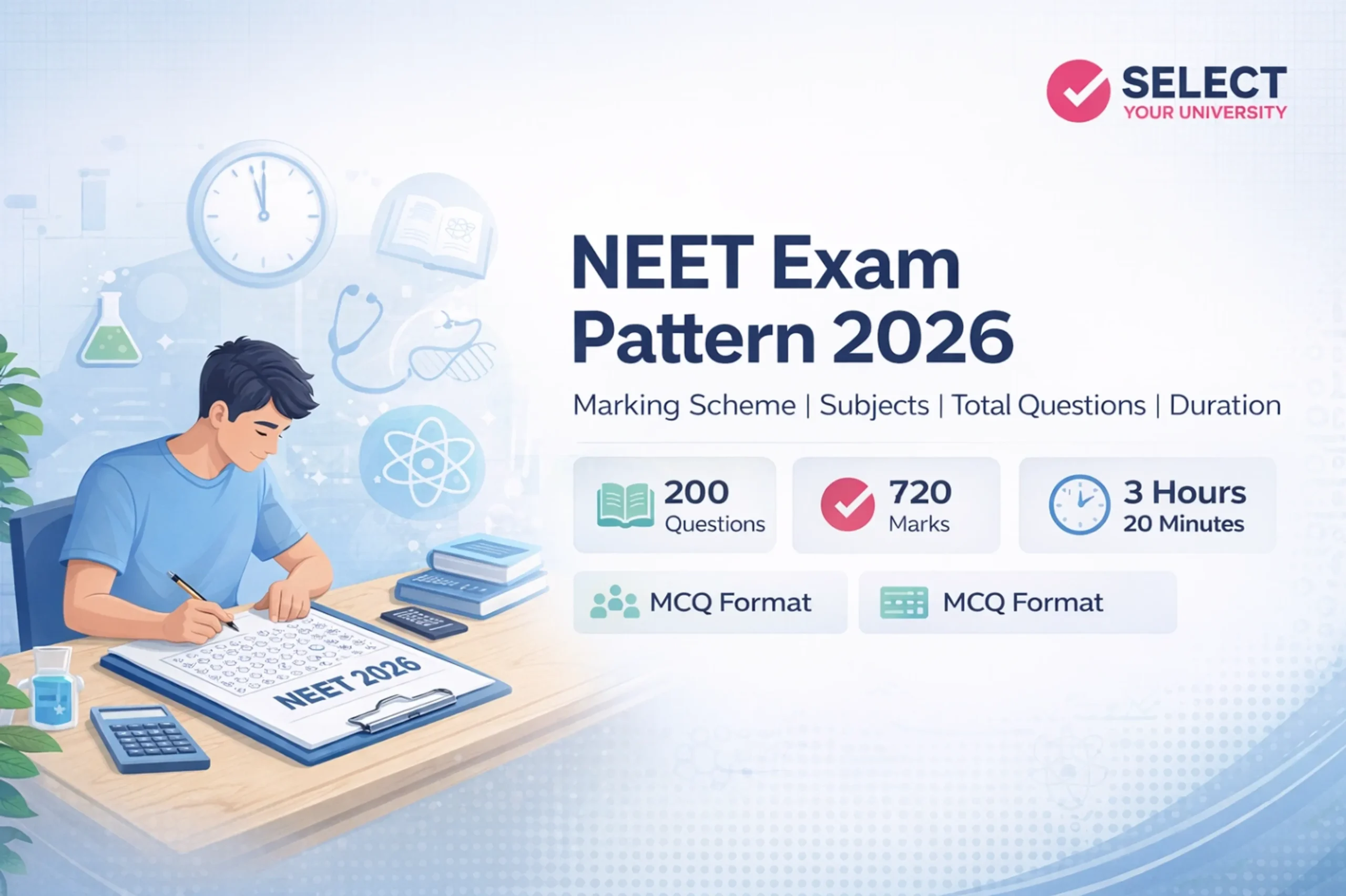
What is NEET UG?
NEET UG is India’s national-level medical entrance examination conducted for admission into MBBS, BDS, AYUSH, veterinary, and other medical courses. It is one of the most competitive entrance exams in the country.Students from all over India appear for NEET to secure seats in top government and private medical colleges. Since the competition level is extremely high, understanding the exam pattern becomes essential for success.
Why Beginners Struggle to Understand the NEET Exam Pattern
Many students begin preparation by directly studying textbooks or joining coaching classes. However, without understanding the structure of the examination, preparation becomes directionless.Here are common reasons why beginners face confusion:· Lack of awareness about NEET marking scheme· Confusion between board exams and entrance exams· Not knowing chapter weightage· Difficulty understanding MCQ-based preparation· Ignoring time management· Lack of proper guidance· Overdependence on multiple resourcesStudents often realize these mistakes only after writing mock tests. Therefore, learning the exam pattern early can save time and improve preparation quality.
Subject-Wise Distribution in NEET
Understanding these basic details helps students mentally prepare for the exam environment.
The NEET examination is divided into three major subjects:
Biology
Biology carries the highest weightage in NEET.SectionQuestionsMarksBotany45180Zoology45180Total Biology Marks: 360Since Biology contributes 50% of the total marks, students must prioritize NCERT Biology thoroughly.
Important Biology Topics
.Human Physiology
· Genetics
· Ecology
·Biotechnology
·Reproduction
· Plant Physiology
Chemistr
Chemistry is divided into:· Physical Chemistry· Organic Chemistry· Inorganic ChemistryQuestionsMarks45180Important
Chemistry Topics
· Chemical Bonding
· Thermodynamics
· Equilibrium
· Organic Reactions
· Coordination Compounds
· Electrochemistry
Physics
Physics is considered challenging by many students because of numerical problems and conceptual application.
QuestionsMarks
45 180Important Physics Topics
· Mechanics
· Modern Physics
· Current Electricity
· Thermodynamics
· Optics
· Electrostatics
Understanding the NEET Marking Scheme
One of the most important parts of the NEET exam pattern is the marking scheme.
Importance of Time Management in NEET
The NEET exam lasts for 3 hours and 20 minutes. Students need to answer 180 questions within this limited time.Average time available per question:200 minutes180 questions≈1.11 minutes per question\frac{200\ \text{minutes}}{180\ \text{questions}} \approx 1.11\ \text{minutes per question}180 questions200 minutes≈1.11 minutes per questionThis means students get nearly one minute per question.Without time management skills, even well-prepared students may fail to complete the paper.
Effective Time Management Strategy
Biology·
· Complete firstfirst
· Easier and memory-based
· Saves time
Chemistry
· Attempt second
· Mix of theory and numericals
Physics
· Attempt carefully
· umerical calculations require more time
Difference Between Board Exams and NEET
1. Ignoring NCERT
Many students study advanced books without mastering NCERT
.In NEET, especially for Biology, NCERT is the foundation.
2. Not Practicing MCQs
Reading theory alone is insufficient.Students should solve
:· Previous year questions· Topic-wise MCQs· Mock tests
3. Fear of Physics
Physics becomes difficult only when concepts are weak.Daily practice improves confidence.
4. Lack of Revision
Students forget concepts without revision
.Weekly revision schedules are essential.
5. Using Too Many Books
Using multiple resources creates confusion.
Stick to:
· NCERT
· Standard reference books
· Coaching materials
Best Preparation Strategy for Beginners
Step 1: Understand the Syllabus
Before starting preparation, students should understand:
· Important chapters
· Weightage
· Difficulty level
Step 2: Create a Study Plan
A balanced schedule should include:
· Daily revision
· MCQ practice
· Mock tests
Step 3: Focus on NCERT
Especially for:
· Biology
· Inorganic Chemistry
Importance of Time Management in NEET
The NEET exam lasts for 3 hours and 20 minutes. Students need to answer 180 questions within this limited time.Average time available per question:200 minutes180 questions≈1.11 minutes per question\frac{200\ \text{minutes}}{180\ \text{questions}} \approx 1.11\ \text{minutes per question}180 questions200 minutes≈1.11 minutes per questionThis means students get nearly one minute per question.Without time management skills, even well-prepared students may fail to complete the paper.